
Who Gives a Hoot?

In late February, an alternative asset manager halted quarterly exits on one of its semiliquid private credit funds. The gating of redemptions frightened investors at a time when AI fears were mounting and market valuations were wavering. Within days, broader credit markets began showing signs of fear.

For investors, it’s crucial to understand the distinction between the structural issues around private credit fund structure, the true credit risks of the underlying assets, and the origins of systemic risk.

First, we should address what happened with these specific funds. A key point is the relationship between the non-traded assets and the publicly traded vehicle. The nontraded fund was supposed to raise capital privately, build a loan portfolio, then provide liquidity by merging into the publicly traded fund. In the meantime, investors were told they could redeem up to 5% of their shares for cash on a quarterly basis. The asset manager attempted to realize this merger in late 2025. However, since the publicly traded fund’s shares traded lower than Net Asset Value, investors in the non-traded fund viewed this mechanism as a forced loss. Under pressure, the asset manager may have terminated the merger.

Simultaneously, the ‘SAASpocalypse’ was ripping through software stocks based on a narrative that AI will commoditize software. Relevantly, private credit is overexposed to software due to the large degree of private equity acquisitions in the sector.

The concurrent issues melded into a mega-narrative that private credit is a systemic risk on the verge of collapse. The shares of asset managers and publicly traded BDCs sold off sharply. Disaggregated, investors responded to three different narratives with differing implications and relevant timelines.

Liquidity

Are investors in private credit vehicles selling under the belief that the underlying assets are not performing? Do they have immediate needs? Or do they see other investors rushing toward the exits? Regardless of the motivation, if people are trying to redeem their shares in amounts greater than is permitted by the fund – generally 5% of shares per quarter – the gating of redemptions may be portrayed as a failure of the asset class. But, in our opinion, this criticism is misguided. The gates are key to functioning. The underlying asset – the loans – do not trade on a sizable secondary market. A run on the funds would lead to fire sales of the loans and make it harder to distribute marginal redemption requests. The asset class is sold as illiquid; the illiquidity premium is supposedly the source of outsized returns. The vehicles should be re-branded from ‘semi-liquid’ to ‘hardly liquid.’ The fund structure tries to move these illiquid assets into a partially liquid vehicle. This structure works fine when stress is low, but most investors would want liquidity at the same time as everyone else.

Transparency

A big knock on private credit is the lack of continuous price action on the loans. External observers see funds move loan prices from par to zero instantly when borrowers default. For funds, there’s some logic to this. On their end, they see borrowers paying the interest until they stop paying. Alternatively, they can rework the debt with payment-in-kind – which converts cash payments into additional debt – or other mechanisms, so they can say that the borrower is technically paying in full. The fund structure is once again what connects the underlying loans to the pricing logic of the open market. The ZIRP era and private market boom allowed valuation practices to go largely unscrutinized. Investors don’t ask too many questions about valuation methods when returns are good, stress is low, and nobody’s demanding cash. When narratives turn, people start criticizing the valuation and pricing process. Investors start asking deeper questions about the nature of these assets. The angst turns ontological: what are prices and where do they come from? Are prices derived from a fundamental value or are they what a buyer is willing to give? In an efficiently traded market, these are supposed to be the same. In private credit, the assets are rarely traded. Value is a phenomenon of accounting on fund books, rather than expressed through exchange. In public markets, prices are meant to indicate the broad market opinion of credit quality. In private markets, value is an internal assessment. Produced not discovered. This distinction is irrelevant in calm periods but is critical when investors want to exchange their holdings and shares for real cash.

Credit Quality

The structural concerns about fund design and the larger macro narrative around software converge on the quality of the underlying loans. The structure and the narrative feed back into each other. Private credit is heavily exposed to software companies acquired by PE sponsors at high leverage multiples justified by recurring revenues and large profit margins. If AI commoditizes software and compresses margins, the ability to service debt deteriorates. When this concern – which has not been observed in earnings data – arises, the fund structure can add fuel to the fire. In public markets, opinions on credit risk can be expressed through transactions; the changing price is a public signal. In private markets, market participants are free to imagine the value of underlying assets. There is no published earnings data on the underlying borrowers. When times are good, actors can assume the loans are more valuable than they are so there’s no volatility. When crisis hits, actors can project larger losses than the loan would have if publicly traded. They seek the closest avenue to price discovery through transaction: the redemption of fund shares. When the asset managers gate redemptions, investors ask: are they keeping me in the fund because the assets are not as valuable as the manager says? The three concerns are mutually reinforcing. Together they create a feedback loop that looks like systemic risk even if the actual credit losses turn out to be modest. However, the credit could be that bad. We cannot know until a borrower defaults; there’s no published data on debt coverage capacity. But the point remains: the structural issues around fund design are not themselves evidence of deteriorating credit quality. They are evidence that the vehicle is not built for stress.

The drama spread to the rest of the private credit industry. The fund structure problems collided with a macro narrative and created suspicion about the whole sector. The ‘2008 again’ comparisons are everywhere online; any collateralized structure or bit of leverage is seen as a reincarnation of subprime mortgage lending and CDOs. The question of systemic risk and interconnection is real. Private credit sits between private equity leverage, bank lending, insurance company balance sheets, and institutional allocation to alternatives. However, this incident is not a systemic meltdown but a stress test of semi-liquid vehicle design. When a true credit crisis happens – exposing variation in underwriting standards – and private credit losses propagate through the financial system, transmission channels will matter more than narrative.

Steven J. Wagner, Investment Adviser
Bray Farm Income Advisory LLC
3375 Brookdale Drive, Pittsburgh PA 15241
412.504.9412
412.848.2410 (cell)

Registered Representative offering securities through Cetera Advisors LLC, member FINRA/SIPC. Advisory Services offered through Cetera Advisers LLC, a Registered Investment Adviser. Cetera is under separate ownership from any other named entity.

The views stated in this letter are not necessarily the opinion of Cetera Advisors LLC. Due to volatility within the markets mentioned, opinions are subject to change without notice. Information is based on sources believed to be reliable; however, their accuracy or completeness cannot be guaranteed. Past performance does not guarantee future results.

Business Development Companies (BDCs) are a type of closed-end investment company that invests in small and mid-sized businesses. BDCs are subject to risks including illiquidity, credit risk, interest rate risk, leverage risk, and valuation risk. Shares of non-traded BDCs may not be redeemable and are subject to restrictions on transferability. Investors should carefully consider the investment objectives, risks, charges, and expenses before investing.

Exchange-traded funds are sold only by prospectus. Please consider the investment objectives, risks, charges and expenses carefully before investing. The prospectus contains this and other information about the investment company, can be obtained from your financial professional at 412.504.9412. Be sure to read the prospectus carefully before deciding whether to invest.

All investing involves risk, including the possible loss of principal. There is no assurance that any investment strategy will be successful.
Treasury Hide and Seek

The “Sell America” anxiety is back, driven by new geopolitical flashpoints and concern about US policy risk. Market observers present lots of handwringing on days when equities, the dollar, and Treasuries slide simultaneously. Flows out of equities and dollars have mechanical explanations; years of strong performance have forced portfolio managers to overweight exposure to US equities, and the dollar has been historically overvalued due to its role in trade and reserve status. The greatest concern, however, is centered around foreign ownership of Treasury bonds. A recurring fear is that foreign powers could “weaponize” their holdings by dumping them on a large scale. Most recently, a rumor ran through markets in July that Japan dumped its massive reserves in retaliation for the ongoing trade dispute. A geopolitically driven fire sale has not been born out in the data. We believe the dynamics suggest that a mass dumping of Treasury bonds is not likely.

The largest foreign holders are currently Japan, China, the UK, and NATO-member EU nations. For these actors, selling is currently constrained by market structure, their own balance sheets, and geopolitics.

  • Treasuries are still the lubricant of international trade and financial markets, functioning as near-money through their role as collateral in secured short-term funding markets. Global financial activity finances its activities through secured borrowing, and the massive liquidity, depth of market and low credit risk of Treasuries have made them the primary form of collateral. Simultaneously, global trade and cross-border balance sheets remain dollar centric. Local banks and exporting businesses have assets and liabilities denominated in dollars, regardless of their transacting directly with the US. In a world of dollar transactions, Treasuries are the most scalable dollar-denominated store of liquidity that can be mobilized immediately for funding, hedging, and settlement.
  • Any en masse dumping would incur massive execution and mark-to-market costs. The Treasury market is deep, but not deep enough to absorb hundreds of billions or trillions of dollars in sales in a short time span without sharp price concessions. As dealers and end-buyers reach balance sheet and risk limits, market depth thins and bid-ask spreads widen. The seller then faces both worse realized execution prices and adverse mark-to-market moves on the portion of the portfolio that has not yet been liquidated. In practice, that devaluation often shows up at home as higher risk premia, driving wider funding spreads, reduced market-making capacity, and a generalized pullback in domestic lending and trade finance.
  • The geopolitical risk is massive. The relationship between the US and a nation dumping its holdings of Treasuries would have to have escalated to the point of near armed conflict. China is trying to position itself as a rational, non-imperial alternative hegemon to the United States. Their selling would appear highly reactionary. The EU and Japan, despite current popular sentiment, are too interlinked with the US. This action would decimate their own economies and destroy any relationship with their largest partner. Less broadly, Treasuries, even if owned by sovereign entities, remain firmly on US-controlled payment rails. Transactions are settled eventually through Fedwire or U.S.-regulated correspondent banks. The 2022 freezing of Russian reserves showed an ability and willingness to use this lever in geopolitical conflict.

We view the risk of a sudden Treasury fire sale as low over a 1–3 year time horizon. That said, if geopolitical tensions intensify and global settlement patterns gradually diversify away from the dollar, the incentives at the margin could shift. The more realistic risk is not a one-day liquidation, but a slow change in the composition of the marginal buyer of new Treasury issuance—potentially increasing volatility and term premium at times.

Steven J. Wagner, Investment Adviser
Bray Farm Income Advisory LLC
3375 Brookdale Drive, Pittsburgh PA 15241
412.504.9412
412.848.2410 (cell)

Registered Representative offering securities through Cetera Advisors LLC, member FINRA/SIPC. Advisory Services offered through Cetera Advisers LLC, a Registered Investment Adviser. Cetera is under separate ownership from any other named entity.

The views stated in this letter are not necessarily the opinion of Cetera Advisors LLC. Due to volatility within the markets mentioned, opinions are subject to change without notice. Information is based on sources believed to be reliable; however, their accuracy or completeness cannot be guaranteed. Past performance does not guarantee future results.

Exchange-traded funds are sold only by prospectus. Please consider the investment objectives, risks, charges and expenses carefully before investing. The prospectus contains this and other information about the investment company, can be obtained from your financial professional at 412.504.9412. Be sure to read the prospectus carefully before deciding whether to invest.

All investing involves risk, including the possible loss of principal. There is no assurance that any investment strategy will be successful

Easing into Ambiguity

Next week the Fed has its September meeting and will decide the next move for monetary policy. Markets are essentially – over 90% — certain that the FOMC will decide to cut the Federal Funds Rate by 25 basis points (bps), resuming the rate cut cycle started last fall. Since March 2023, the 2-year Treasury yield has remained below the effective federal funds rate — a historically reliable signal that markets anticipate lower policy rates.

On the long end of the curve, however, the effect of rate cuts is more ambiguous. Longer yields are a composite of policy rate trajectories and a term premium that reflects perceptions of duration risk, supply & demand dynamics, inflation expectations, and fiscal concerns. Generally, you’d expect rate cuts to lower the policy rate trajectory and thus lower the bond’s yield. But if the lower policy rate disproportionately increases medium term inflation expectations, the bond yield may rise.
After last September’s rate cut, the 10-year yield climbed 80 bps over the next two months. We need to ask: will the 10-year yield climb again after next week’s presumed rate cut?

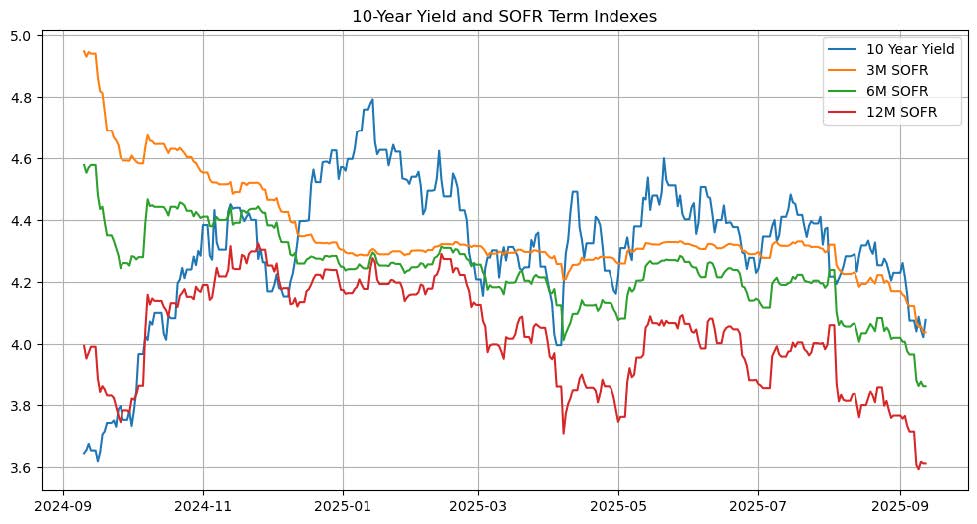
We can start by disaggregating the changes in policy rate assumptions on the recent changes in the yield. We use the secured overnight financing rate (SOFR) Forward Curve to extract changing market expectations on the policy rate trajectory. Year to date, the 10-year yield has fallen 50 bps. Using principal component analysis, we found that changes in SOFR term forwards have decreased the 10-year yield by 38 bps. This number is the relative contribution of policy rate expectations to the yield.


Data from Bloomberg

Next, we need to think about the term premium. The analysis from above implies that term premium compression has contributed 12 basis points to the overall change in the 10-year yield. We can look at relevant macro-factors to disaggregate market perceptions on inflation, global growth, and supply/demand.
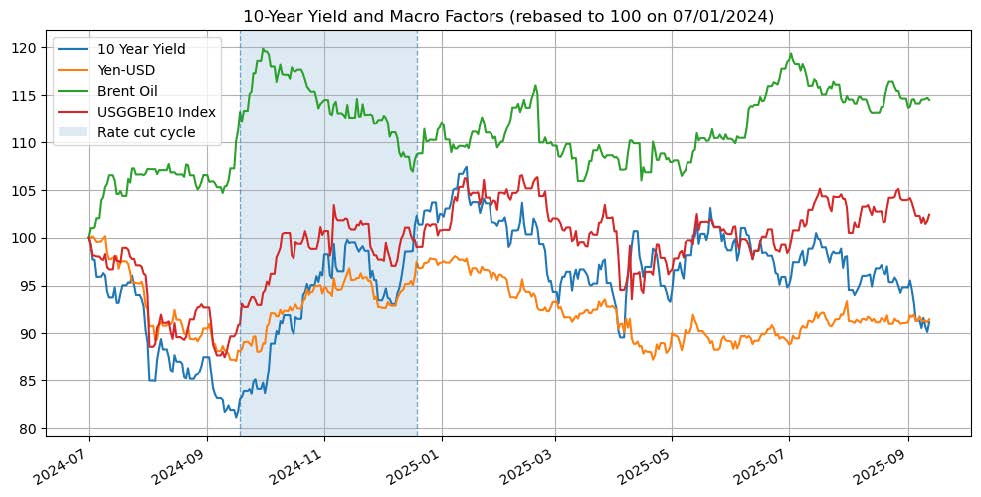
Three simple, relevant factors are the dollar-yen exchange rate, oil prices, and 10-year breakeven rates. The yen is tied to US Treasury yields through a few vectors, like status as safe harbor assets, long-standing policy rate differentials, and trade-driven capital flows. Oil prices are a bellwether for macro conditions. Prices reflect changing global demand; increasing oil prices signal economic growth. Robust economic growth lowers the probability of future rate cuts, increasing yields. The 10-year breakeven is the anticipated inflation, equal to the difference between the 10-year yield and the yield on the 10-year

inflation adjusted bond (TIPS).

Data from Bloomberg

Last year’s rate cuts in September coincided with renewed climbs in oil prices and breakeven rates. The yen initially strengthened into the cut, then reversed once rate differentials began widening. A larger term premium, driven by sticky inflation expectations and strong oil demand, outweighed the mechanical effects of easier policy. Ahead of the upcoming rate cut, conditions look different.

Oil has fallen from its peak. Breakevens, though higher, are stable. Likewise, the yen appreciated early in 2025 and has stayed within a tight range since May. These signals and the year-to-date price action indicate that the 10-year is likely to remain within its current trading range.

However, there is a risk that the Fed’s guidance indicates a slower cut path than is priced in by the market. The market currently has priced in a trajectory to a terminal neutral rate that is 2 years earlier than the Fed’s own measure. If the dot plot shows only 2 cuts, the 12-month term SOFR may rise relative to the 3- and 6-month terms. If the entire curve shifts together – change in level – the 10-year is not affected, but a change in slope has an impact.

Unfortunately, these two conflicting factors balance each other out; the probability of the 10-year increasing is 50.2%. Though the direction of rates is ambiguous, we can focus on potential volatility. We forecast lower volatility than last year’s cycle. Our model projects less than 50 bps of change in the 10-year yield with a 95% confidence interval. However, if the Fed suggests a slower rate cut path, the 12-month SOFR term may rise relative to the 3- and 6-month terms. A 10 bps relative increase in the 12-month has a median change of +12 bps in the 10-year yield. All of this assumes no exogenous shocks such as geopolitical events or surprise changes in economic conditions.

Steven J. Wagner, Investment Adviser
Bray Farm Income Advisory LLC
3375 Brookdale Drive, Pittsburgh PA 15241
412.504.9412
412.848.2410 (cell)

Registered Representative offering securities through Cetera Advisors LLC, member FINRA/SIPC. Advisory Services offered through Cetera Investment Advisers LLC, a Registered Investment Adviser. Cetera is under separate ownership from any other named entity.

The views stated in this letter are not necessarily the opinion of Cetera Advisors LLC. Due to volatility within the markets mentioned, opinions are subject to change without notice. Information is based on sources believed to be reliable; however, their accuracy or completeness cannot be guaranteed. Past performance does not guarantee future results.

Exchange-traded funds are sold only by prospectus. Please consider the investment objectives, risks, charges and expenses carefully before investing. The prospectus contains this and other information about the investment company, can be obtained from your financial professional at 412.504.9412. Be sure to read the prospectus carefully before deciding whether to invest.

Purchasing Power Despairity

The narrative around the macroeconomy has summoned the scary specter of stagflation. The growth story is relatively clear. We have lingering recession signals from 2023 that never coalesced into a real recession; the changing policy landscape is a catalyst for realizing underlying weakness; tariffs are effectively a nominal tax with the same effects on output. The simple story for inflation is the same: tariffs raise prices on imports. For the sake of conversation, a lot of rhetorical weight rests on the definition of inflation. Politically, inflation is when stuff costs more. Tariffs will cause political inflation. Economically, inflation is a sustained increase in the price level of goods. Semantically, tariff implementation does not cause inflation because it represents a one-time increase in prices. So why are we all predicting inflation?

The Fed

This week the Bureau of Labor Statistics released revisions for hiring numbers from May and June. The initially reported job growth was downgraded to anemic numbers. In response, the implied market odds of a September rate cut jumped from 40% to above 90%. However, the latest inflation print – PCE numbers from June – jumped to 2.6% YoY, a 4-month high.

I’m not sure, though, that changing the Fed Funds Rate will mechanistically increase inflation. Indicators of monetary ease have been suggesting that conditions in funding markets have remained loose, despite a persistently high FFR. The latest economic cycle has been a story – in part – of income, rather than credit. The current marginal consumer is increasingly wealthier, whose income is in greater part linked to income-producing assets. Cutting rates would decrease the nominal income of the largest consumer base.

The Fed’s impact is its setting of expectations. The Fed has ostensibly held rates steady through 2025 for a stated fear of reigniting inflation. The price pressures they’ve discussed have not disappeared. A premature cut risks de-anchoring expectations if services inflation and other signals remain inconsistent with 2% target. Firms, no longer confident in a concerted policy effort toward 2% inflation, will begin directly pricing in their expectations into forward-looking contracts, reinforcing an inflationary push.

The Dollar

An alternative view of inflation is the drop in the purchasing value of a dollar against a basket of goods and services. Usually, the causality is thought of as flowing from inflation to the dollar; inflation weakens the purchasing power of the dollar relative to foreign currencies. Since such a large portion of goods consumed in the US are imported, the value of the dollar against foreign currencies has a large impact on the price of domestic goods. Tariffs were originally expected to raise the value of the dollar, offsetting the price increases. Instead, the new policy catalyzed a selloff of the dollar.

A bearish dollar is one of the most crowded trades. Non-commercial future positions – a proxy for speculative USD sentiment – are at their most shorted level in 5 years. Cyclical and structural forces are weighing on the dollar index.

Cyclically, the dollar has been historically expensive since COVID. The US’s strong post-pandemic recovery, rate differentials, and safe-harbor liquidity drove large global demand for dollar-denominated assets. The global economy has been incredibly long the dollar, so the geopolitical upheaval of April gave global asset allocators a justification for pivoting toward alternative markets. The increasing likelihood of a September rate cut also provides short term impetus for a bearish dollar. Historically, sovereign yields are correlated to the issued currency; a higher yield sees more inflows from investors.1 If investors expect the beginning of a cutting cycle, they’ll rotate into higher yielding assets.

Structurally, the global role of the US dollar is increasingly looked at warily. The dollar has been dominant as the final settlement of global transaction; 88% of FX trading involves the dollar, the dollar share of trade invoicing and cross border liabilities are around 50%, 70% of foreign currency global debt issuance is denominated in the dollar. We do not forecast this role to change catastrophically. There is no alternative with adequate infrastructure or depth of liquidity to handle the scale of flows. The moat-like protection of network effects creates a massive barrier to entry for a competitor system. However, global actors have begun development of alternative payment rails. China in particular has encouraged the expanded use of the renminbi in clearing cross-border transactions. They have used the politicization of US dollar rails – SWIFT sanctions and seizure of Russian USD assets – to

___________________________

1 I’d like to caveat this assumption. Since Liberation Day, correlations between yields and the REER has turned negative. This new relationship is not causal but coincidental. Simultaneously, I expect rate cuts to increase yields on Treasury bonds farther out on the curve (e.g. 5 years and farther). This move is based on the inflation expectation hypothesis I discussed above. Will this yield shift be enough to attract foreign marginal buyers?

push the transition to the Cross-border Interbank Payment System (CIPS) for renminbi transactions and the development of renminbi-denominated oil futures on the Shanghai Exchange. These efforts remain limited and won’t kill the dollar, but they limit the breadth of marginal actors in the US dollar system.

Tariffs

Ok. I know I said the tariffs won’t cause inflation. To clarify, the primary policy does not specifically drive a long-term change in price level. This intuition does not factor in the re-organization of trade networks. Tariffs and proactive trade policy do not just change the price of goods; they change the costs of transacting. For example, imagine you’re a Spanish wine manufacturer/exporter. You’re costs of goods were $30 per bottle, but now, there’s a 15% tariff on your export. Do you pay the difference out of your margin? Do you pass the price to the wholesaler? Also, previously you were paying $3 per bottle from a Chinese manufacturer. Do you pay an extra tariff based on transshipment policy?
This example happens globally. When the marginal cost increases on these decisions costs millions of dollars, firms may be forced to re-select suppliers and change the network structure of value chains. The free trade system optimized supply chains for marginal cost. Re-ordering the network of trade has inherit frictional costs and decreases in long-term efficiency

If trade policy continues to dynamically evolve, the strength of these frictions becomes increasingly relevant.

The Outlook

We project YoY PCE to max out at 3.5% in October/November 2025. This spike will reflect the initial primary rise in the price level from tariff implementation. Over the next 3-4 years, the inflation rate will settle closer to 2.5%, rather than the target of 2%. Structural realignment of global supply chains and the effects of persistently high deficits will limit the capacity of monetary policy to meaningfully fight inflation. In this base case, investors will need to prioritize actively preserving purchasing power as well as maximizing nominal returns.

Steven J. Wagner, Investment Adviser
Bray Farm Income Advisory LLC
3375 Brookdale Drive, Pittsburgh PA 15241
412.504.9412
412.848.2410 (cell)

Registered Representative offering securities through Cetera Advisors LLC, member FINRA/SIPC. Advisory Services offered through Cetera Investment Advisers LLC, a Registered Investment Adviser. Cetera is under separate ownership from any other named entity.

The views stated in this letter are not necessarily the opinion of Cetera Advisors LLC. Due to volatility within the markets mentioned, opinions are subject to change without notice. Information is based on sources believed to be reliable; however, their accuracy or completeness cannot be guaranteed. Past performance does not guarantee future results.

Exchange-traded funds are sold only by prospectus. Please consider the investment objectives, risks, charges and expenses carefully before investing. The prospectus contains this and other information about the investment company, can be obtained from your financial professional at 412.504.9412. Be sure to read the prospectus carefully before deciding whether to invest.

The Tortoise and the Haircut

It’s no secret that the United States has a lot of debt to finance. If you’re on Truth Social or listen to long-only equity managers, you also know that interest rates are high – relative to the last decade. Issuing on the long end of the curve right now would lock in a higher cost of borrowing for the maturity of the issuance. Instead, the Treasury can tilt issuance toward short-term bills. The government can continue to pay its liabilities then finance the current debt when interest rates are appropriately low. This maneuver, however, carries a rollover risk if long-end bond yields remain stubbornly elevated.

At the same time, the Treasury Secretary needs to find buyers for all this debt to finance. As national external wholesaler in chief, Secretary Bessent’s job is to find someone willing to hold US debt with the looming promise of supply increases. The two answers he’s come up with are stablecoins and banks. To encourage large banks to hold more Treasury securities on balance sheets, the Fed has proposed changes to the supplementary leverage ratio (SLR). For further details, please refer to my writing from April 22.

In that piece, I mentioned the risk of increasing systemic vulnerability and leverage in money markets. To understand where that risk may come from, we need some context. Before the Great Financial Crisis (GFC), banks served a larger role in financial intermediation. Starting in the 1980s, banks started underwriting the rapidly growing derivatives market. Each trade earned a small marginal fee, so banks held increasingly large levels of leverage on their balance sheets. By 2008, the notional exposure to the derivatives market was $176 trillion while maintaining 48x balance-sheet leverage. After the GFC, new banking regulations – including the SLR – increased the cost of expanding balance sheets and rendered market-making activity unprofitable for the large banks. Hedge funds have stepped in to fill the role of highly levered relative value arbitrage traders.

In today’s basis trade ecosystem, many hedge funds buy Treasuries, finance them in bilateral repo, and short the matched futures or pay-fixed swaps, locking in the cash–derivative spread. Banks supply the leverage and collateral transformation but leave the market risk with the fund. In May of this year, Lina Lu and Jonathan Wallen published a great paper analyzing the practices of banks in the repo market. They found that banks are frequently lending against US Treasury collateral at a negative haircut. This means that – for example – they’ll accept $100 of collateral for $101 in cash. For the banks, this pricing allows them to effectively bundle two loans together: a secured leg equal to the value of the collateral and an unsecured leg that represents the remainder. This regulatory arbitrage lets banks execute riskier loans that are nominally collateralized by safe Treasury assets without having to allocate expensive equity on the balance sheet. However, the banks are taking on credit counterparty risk. If the non-bank financial institutional borrower defaults, the unsecured portion of the loan enters the general pool of ordinary, unsecured claims.

This practice is correlated with a bank’s ability to function as a security warehouse. ‘Warehouseness’ can be thought of as the degree to which a bank is a net lender in the repo market; an adaptive balance sheet lets a bank hold Treasuries through volatility and fire sales. By selling futures or paying the fixed leg of a swap, warehouse banks can hedge the interest rate risk of holding Treasury securities and earn positive arbitrage carry by renting balance sheet capacity.

The two recent policy initiatives are going to push haircuts further negative thus increasing leverage in the non-bank financial intermediaries (NBFI) sector. First, the deluge of bill issuance is going to cheapen the cost of collateral in the market. This cheapening occurs because of both Econ 101 and financial processes. The easy answer is price goes down when supply goes up, so repo lenders can’t demand as relatively high a haircut when the collateral is less expensive to obtain. Financially, the value-at-risk model used to calculate haircuts are a function of dollar losses. As yields increase – and mathematically the price decreases – the dollar duration of a bond decreases. A less expensive bond has less to fall than a more expensive bond.

A counter to this vector of haircut decrease would be the loss in repo liquidity from money market funds (MMF). MMFs tend to be more active participants in the repo market when bills are scarce. The rate of banks’ lending, however, is a function of balance sheet capacity and liquidity of the underlying collateral. The cost of allocating scarce balance sheet equity toward lending is more expensive than the changes in supply dynamics from MMFs.

This leads us to the second change in governance: the lifting of the SLR. At the current 5% level for the largest banks, each $100 billion lent in the repo market consumes $5 billion in balance sheet equity. Changing the SLR gives banks more room on their balance sheet to extend leverage to NBFIs. In recent history, the Fed issued an exemption from the SLR limits during COVID. As the exemption took effect in the market, the Fed’s FR 2052a filings show the share of negative-haircut reverse-repo trades jumping from ~10 % (Mar-2020) to >60 % (Dec-2020). Lu and Wallen estimate that a 1% decrease in the SLR leads to an 18 bp decrease in haircuts.

Systemically, the move in haircuts increases the leverage in the NBFI system and has secondary impacts on the liquidity of the underlying market for US Treasuries. Just as an increased capacity for warehousing is associated with extending leverage, warehouse dealers are more prone to cyclicality in lending practices. If yields fall too far or balance-sheet costs tighten, the warehouse dealers pull back funding and revert to positive haircuts, triggering a pro-cyclical unwind in leveraged positions. The fire sale dynamics can dry up liquidity and force the Fed to re-engage in market supporting activities.

As regulatory policy makes balance sheet space cheaper and haircuts continue sliding below zero, NBFIs can leverage their activity through the repo market. The extra liquidity doesn’t just sit in the Treasury market. Risk assets – especially tech stocks and crypto – can get a price lift as buyers bid faster in larger lots. However, this trade is dependent on the rising tide in the repo market, but when liquidity dries up, the positions are quickly unwound. We see a short-term boost for risk assets as leverage percolates through the system.

Lu, L. & Wallen, J. (2025). Negative Treasury Haircuts. Available at SSRN: https://papers.ssrn.com/sol3/papers.cfm?abstract_id=5239611

Steven J. Wagner, Investment Adviser
Bray Farm Income Advisory LLC
3375 Brookdale Drive, Pittsburgh PA 15241
412.504.9412
412.848.2410 (cell)

Registered Representative offering securities through Cetera Advisors LLC, member FINRA/SIPC. Advisory Services offered through Cetera Advisers LLC, a Registered Investment Adviser. Cetera is under separate ownership from any other named entity.

The views stated in this letter are not necessarily the opinion of Cetera Advisors LLC. Due to volatility within the markets mentioned, opinions are subject to change without notice. Information is based on sources believed to be reliable; however, their accuracy or completeness cannot be guaranteed. Past performance does not guarantee future results.

Exchange-traded funds are sold only by prospectus. Please consider the investment objectives, risks, charges and expenses carefully before investing. The prospectus contains this and other information about the investment company, can be obtained from your financial professional at 412.504.9412. Be sure to read the prospectus carefully before deciding whether to invest.

Fed Up?

Fed Up? The Federal Reserve plays a crucial, underappreciated role in the global economy: an easy scapegoat. Democrats and Republicans, Presidents, CEOs, day traders—all can and will blame the Fed for any market outcome that does not meet their personal expectations. There’re a few clear psychological drivers for this allocation of blame. One, the Fed is perceived as inherently weird and insular. It has a sort of village witch or shaman cast to it. Us mere mortals are not always privy to the inner workings and are confused by its operating. In times of stability, this relationship is ok. When things are volatile, we look to blame the arcane institution we don’t understand. Two, we enjoy feeling like someone is in charge. Like the village witch, we ascribe magical powers to the Fed that can fix all our economic ailments. We discount the insane level of complexity in the economic system and instead feel comforted by the idea that someone out there really has control of the situation. Three, we project our own biases and rational economic positions onto the Fed. Presidents want to be re-elected and maintain political power. CEOs want their companies to make more profits. Day traders want lines to go up. Like a medieval farmer questioning a witch’s relationship to a drought, modern economic actors ask themselves, “Why won’t the Fed fix my problems?”

Last week the Fed decided, again, to do nothing. Once again, certain people – the White House – were displeased by this decision1. Chair Powell’s and other officials’ comments from the announcement reflected the cautious, hold-your-breath conditions the Fed is operating under. To be frank, I’m not a huge fan of Fed watching. At this moment, fiscal dominance and geopolitical efforts are threatening to change the global capital structure. Time is a resource and it’s worth following and understanding the deeper changes. However, it’s a good exercise to understand the Fed’s reaction function and the arguments why the Fed is wrong.

Why cut rates? The argument for cutting rates is based on economic momentum. The Fed had raised rates to combat inflation in 2021, and the Fed had begun in Fall 2024 returning rates to a normal level. Even now, the rate is probably around 1 percentage point above the neutral rate. Proponents of resuming cuts point to weakening employment data. The jobs market is in some sort of stasis. Gross unemployment numbers remain strong and layoffs are muted, but hiring has frozen entirely. The labor market appears fragile. Rate doves argue that the Fed should not wait to see layoffs to resume cutting.

Why not cut rates? The stated reason for the prolonged wait is the price effect from tariffs. Classical economic theory says that tariffs are a one-time increase in the price level. Classical economic theory, however, does not address the nonlinear interactions from complex supply chains or the use of geopolitical leverage. The Fed believes the probability that tariffs cause a sustained increase in prices is large enough to justify waiting. There’s another good psychoanalytic analysis here. After calling the initial signs of inflation in 2021 ‘transitory’, the Fed waited too long to address what was obvious to everyone else. The resultant criticism may have stuck to Powell’s psyche; he’s not willing to appear blasé about prices2.

There’s additional lurking pressure from the bond market. The long end of the curve has been looking more and more unanchored from monetary policy. Last fall, the rate cuts drove a sustained rise in yields in the 10- and 30-year tenors. A continued robustness in macro data suggested a higher floor for the cutting cycle than believed in August. At present, the Fed may be worried about the bond market’s reaction once again to preemptive rate cuts. Macro data is weaker; however, the fiscal situation is at the forefront of investors’ minds and Powell himself has been discussing worries over inflation. Furthermore, public statements from the White House have put political pressure on the Fed to loosen rates. If the Fed cuts before a deterioration of labor-side data, the bond market may start asking some big questions. How reactive is the Fed to political pressure? Is the Fed choosing to ignore its own statements on the stable price side of the dual mandate? The situation is loaded with irony. If the Trump Administration gets what it wants and the Fed cuts rates, we may see a blowout in 10-year yields. At a moment when mortgage rates and consumer stress are at a sustained high, this may be far more politically damaging than the results of monetary policy. It’s a better political move to keep blaming the village witch for not managing rainfall than to try and take the problem into your own hands.

  1. At least publicly. Does President Trump really want the Fed to cut rates? Imagine if Powell cuts rates, President Trump takes some drastic policy action, and we still get market volatility. Who could he blame then?
  2. I think there’s something deeper here about the wider socio-political response to higher prices versus unemployment. The promise of globalization was an offshoring of manufacturing to capture price efficiency for inputs. American consumers were sold on cheap goods. For the first time in decades, the voting consumer had to face the realities of inflation.

Steven J. Wagner, Investment Adviser
Bray Farm Income Advisory LLC
3375 Brookdale Drive, Pittsburgh PA 15241
412.504.9412
412.848.2410 (cell)

Registered Representative offering securities through Cetera Advisors LLC, member FINRA/SIPC. Advisory Services offered through Cetera Advisers LLC, a Registered Investment Adviser. Cetera is under separate ownership from any other named entity.

The views stated in this letter are not necessarily the opinion of Cetera Advisors LLC. Due to volatility within the markets mentioned, opinions are subject to change without notice. Information is based on sources believed to be reliable; however, their accuracy or completeness cannot be guaranteed. Past performance does not guarantee future results.

Exchange-traded funds are sold only by prospectus. Please consider the investment objectives, risks, charges and expenses carefully before investing. The prospectus contains this and other information about the investment company, can be obtained from your financial professional at 412.504.9412. Be sure to read the prospectus carefully before deciding whether to invest.

When Donald Met Hashimoto

When Donald Met Hashimoto President Trump has put an end to the will-they-won’t-they romcom drama around the proposed purchase of US Steel* by Japanese steel-manufacturer Nippon*. This all comes after President Biden rejected the deal in January citing national security concerns and after President Trump stated that this deal would never happen. Nippon committed to concession after concession during the saga: promising to maintain the current collective bargaining agreement, offering $2 billion to rehabilitate a Mon Valley plant outside of Pittsburgh and a $3.1 billion investment in the Gary, Indiana facility, and a 142% share price premium over the next highest bidder.

However, Nippon had to sacrifice something even larger to make this deal happen: sovereignty. The United States government is assuming some sort of oversight role as a condition for allowing the deal. The details and formal legal structure are still forthcoming, but I assume the US will have certain veto powers like approval of board members and limiting decline in veto powers.

US Steel shareholders are compensated at a premium over prior trading levels. For the United States Government/Trump Administration, this is a win. They get the transfer of foreign capital into a strategically important industry while maintaining a politically acceptable level of control. Nippon has managed to maintain competitiveness with Chinese steel producers despite operating in a high-cost environment that relies on imported inputs and a more complex, off-book supply chain. The US has an opportunity to onshore expertise in a crucial industrial process.

This deal may represent an important moment in the Trump administration’s stated project to reshore industrial capacity. In this realpolitik world, the Committee on Foreign Investment in the United States (CFIUS) is a powerful tool for guiding foreign capital toward strategic ends. CFIUS was formally instituted in 2007 to review transactions that could result in control of a U.S. business connected to national security. The scope of its oversight and use cases have expanded over time; a 2022 Executive Order instructed CFIUS to weigh a transaction’s impact on supply-chain resilience, technology leadership, access to strategic minerals, and data integrity.

I can imagine a world where CFIUS is a crucial part of a renewed focus on industrial policy. From a financial perspective, CFIUS can be used to guide investment toward strategic goals. Currently, the United States is largest global recipient of Foreign Direct Investment.
The re-negotiations of trade agreements combined with a dual-track CFIUS approval process can give preferential treatment to allies and strategic partners willing to make investments. By providing a carrot as well through tax credits or regulatory easing for strategically valuable industrial projects, the administration could shepherd foreign capital into the repatriation of manufacturing. We are closely following legislative efforts to determine who stands to benefit from this push.

Steven J. Wagner, Investment Adviser
Bray Farm Income Advisory LLC
3375 Brookdale Drive, Pittsburgh PA 15241
412.504.9412
412.848.2410 (cell)

*This commentary mentions both US Steel and Nippon. These companies are cited since they represent core components to recent news releases that may have broader macroeconomic implications. Importantly, the inclusion of these companies does not constitute an investment recommendation of their issued securities either by the Registered Representative or Cetera Advisors LLC.

Registered Representative offering securities through Cetera Advisors LLC, member FINRA/SIPC. Advisory Services offered through Cetera Advisers LLC, a Registered Investment Adviser. Cetera is under separate ownership from any other named entity.

The views stated in this letter are not necessarily the opinion of Cetera Advisors LLC. Due to volatility within the markets mentioned, opinions are subject to change without notice. Information is based on sources believed to be reliable; however, their accuracy or completeness cannot be guaranteed. Past performance does not guarantee future results.

Exchange-traded funds are sold only by prospectus. Please consider the investment objectives, risks, charges and expenses carefully before investing. The prospectus contains this and other information about the investment company, can be obtained from your financial professional at 412.504.9412. Be sure to read the prospectus carefully before deciding whether to invest.

Deal or No Deal for Another 90 Days

Deal or No Deal for Another 90 Days We got a deal! Or rather an agreement to walk back from the edge of an effective trade embargo for 90 days. For the time being, this has been good for the highly news-reactive equity market – the S&P 500 is up year to date. But has anything changed fundamentally?

The tide of geoeconomics had already turned before President Trump’s administration. Foreign central banks responded to the weaponization of the SWIFT network and seizure of Russian dollar-denominated assets by paring their reserve holdings of US Treasuries in favor of gold and US mega cap equities.

The combination of DeepSeek in January, a potentially militarized European fiscal policy, and the tariff saga have reminded investors that ex-US markets may have equally compelling narratives at more attractive prices. The medium-term outlook is a continued weaking of the US dollar and foreign outflows from US equities, assuming no major positive externalities or immediate productivity booms from AI. This movement has a floor, however. The world is not going to abandon – yet – the US dollar as the clearing currency for foreign trade, which limits potential downside. Further, if the US pursues a coherent industrial policy, there will be winners.

In the short term, equities can ride fiscal stimulus as the administration shifts its focus to tax policy and deregulation.

I think it’s still important to remember that there’s a 30% tariff on China and a 10% baseline on the rest of the world. The tariffs, a weaker dollar, and deficit spending can all contribute to inflation. This past week, the Producer Price Index (PPI) came in with a surprise negative reading, driven by a decrease in services. Firms, wary of sacrificing market share on a shifting policy landscape, accepted lower prices. However, with increasing certainty in the baseline tariff levels, companies will begin passing cost margins on to end consumers.

Steven J. Wagner, Investment Adviser
Bray Farm Income Advisory LLC
3375 Brookdale Drive, Pittsburgh PA 15241
412.504.9412
412.848.2410 (cell)

Registered Representative offering securities through Cetera Advisors LLC, member FINRA/SIPC. Advisory Services offered through Cetera Advisers LLC, a Registered Investment Adviser. Cetera is under separate ownership from any other named entity.

The views stated in this letter are not necessarily the opinion of Cetera Advisors LLC. Due to volatility within the markets mentioned, opinions are subject to change without notice. Information is based on sources believed to be reliable; however, their accuracy or completeness cannot be guaranteed. Past performance does not guarantee future results.

Exchange-traded funds are sold only by prospectus. Please consider the investment objectives, risks, charges and expenses carefully before investing. The prospectus contains this and other information about the investment company, can be obtained from your financial professional at 412.504.9412. Be sure to read the prospectus carefully before deciding whether to invest.

Help! Help! I’m being repressed!

Help! Help! I’m being repressed! While the world’s focus remains on trade and the global flow of real goods, we need to discuss the global flow of financial capital. By accounting definition, a country’s current account – its balance of payments for real goods and services – is equal to its capital account – the flow of financial goods. Since 2006, our current account has slid to a $1 trillion deficit. To settle payment, the United States sends dollars to the exporting nation. Now, the exporting manufacturer and its nation’s central bank have an excess of United States dollars. What’s the best – historically – and easiest thing to do with US dollars? Invest in US dollar denominated financial assets. The largest demanded asset has been Treasury securities1, but foreign investors can also allocate to corporate debt, public equities, and real assets.

As displayed on Liberation Day, the Trump administration views bilateral trade imbalances as inherently bad. Mathematically, if we narrow our current account deficit, we will narrow our capital account deficit. Foreign investment in US dollar denominated assets must fall, and Treasuries will be the most impacted asset class. The short-term effect is an increase in structural yield levels, and the long-term effect is a much more expensive debt balance2.
President Trump and Secretary Bessent have iterated repeatedly that a key goal of theirs is to lower the yield on 10-year Treasuries. With yields rising due to global demand shifts, a bloated government debt weighing on balance sheets, and political pressure to manage costs, the Administration may be left with one option. Financial Repression.

Financial repression is a scary term for a spectrum of regulatory policies aimed at artificially managing interest rates and debt through the banking sector. On the extreme side, governments can explicitly cap interest rates – like during World War II – or place restrictions on demand deposits – Regulation Q banned interest on demand deposits and imposed caps on other deposits. On the subtler side, the Fed could carve out Treasuries from capital requirements or large quantitative easing aimed at capped yield targets. In the short run, financial repression provides a tool for deficit reduction. The stated goals of the administration would lead them right to this option.

I think it’s almost certain that the first tool would be changing leverage and liquidity requirements on domestic banks. Dealers complain that the supplementary leverage ratio (SLR) – the ratio of bank equity to total assets – is the main impediment to participating in auctions. Current bank regulation requires banks to have 3% – or 5% for the global systematically important banks – of their total assets in cash reserves. The Fed, Office of the Comptroller of the Currency, and Federal Deposit Insurance Company could do this tomorrow. Changing the SLR calculation has already been a topic of lobbying and pressure from the banking industry, so the political and industrial will is there already!

For bond yields, this sort of intervention detaches yields from pure macroeconomic fundamentals, at least initially. The path I expect is an initial increase in bond yields as foreign buyers retreat from the primary market, followed by a one-time decrease in yields driven by this policy implementation. As long as inflation remains relatively capped, I expect a downward level shift of 10-15 basis points for the 10-year Treasury, based on similar actions taken during COVID. If hard data begins to show economic slowdown or if volatility remains structurally relevant, we may see yield decreases of 15-25 basis points.

However, in the long run, by increasing leverage in the banking sector, the Fed will be trading a temporarily lower yield for a hotter financial sector with larger systemic risk. Concerns over the basis trade and the ability of the repo market to provide liquidity may start to show cracks in the event of turbulent conditions in the credit market. Furthermore, artificially lower yields may push extra credit creation and deterioration in incentives to save, leading to structurally higher inflation.

  1. The current mix for 2024 flows is $477 billion for Treasuries (40%), $295 billion for corporate debt (25%), and $312 billion for US equities (27%).
    U.S. Department of the Treasury. Treasury International Capital System, U.S. Long-Term
    Securities Held by Foreign Residents. https://ticdata.treasury.gov/resource-center/data-chart-center/tic/Documents/slt_table1.txt
  2. I don’t know if I can get into all the impacts of the US not being able to issue debt at the level it’s accustomed to. In short, I think our consumptive, service-based economy has been centered on America’s unique ability to offer consistently low-cost debt.

Steven J. Wagner, Investment Adviser
Bray Farm Income Advisory LLC
3375 Brookdale Drive, Pittsburgh PA 15241
412.504.9412
412.848.2410 (cell)

Registered Representative offering securities through Cetera Advisors LLC, member FINRA/SIPC. Advisory Services offered through Cetera Advisers LLC, a Registered Investment Adviser. Cetera is under separate ownership from any other named entity.

The views stated in this letter are not necessarily the opinion of Cetera Advisors LLC. Due to volatility within the markets mentioned, opinions are subject to change without notice. Information is based on sources believed to be reliable; however, their accuracy or completeness cannot be guaranteed. Past performance does not guarantee future results.

Exchange-traded funds are sold only by prospectus. Please consider the investment objectives, risks, charges and expenses carefully before investing. The prospectus contains this and other information about the investment company, can be obtained from your financial professional at 412.504.9412. Be sure to read the prospectus carefully before deciding whether to invest.

Risk

What are Treasury bonds really? They’re a bet that US institutions and norms are guaranteed to keep the car on the road. The world expects from the United States (relatively) moderate inflation, clear jurisprudence, political stability, trade cleared in dollars, and a big army to back this all up. Past ‘crises’ – debt-ceiling brinkmanship, quality downgrades from rating agencies, liquidity spooks – have failed to realize any lasting damage to demand for US Treasury securities. Events that should negatively affect the credit quality of the United States government lead to increases in the prices of US debt. After the weirdness of the bond market last week momentarily broke the flight to safety pattern, we need to ask: What could actually break global demand for US Treasuries once and for all? Whatever the catalyst, the buildup will be nonlinear: incremental stresses will accumulate until some financial rupture – I’m looking at you hedge funds – breaks market confidence. Here are some of the main pressure points I’m watching right now.

The Fed Swap Lines have deputized the Fed as a lender of last resort during dollar-denominated liquidity crises in other countries. Foreign private banks, who want assets in dollars, fund long-term dollar assets with short-term dollar debt. The maturity mismatch has been prime for bank-run psychology. In 2007, as the global financial crisis destroyed credit confidence, foreign banks required increasing cash in dollars to cover their dollar exposures, leading to a drought in the supply of foreign dollars. The Fed, fearing contagion, opened a $550 billion swap line with foreign central banks. Through the swap lines, the Fed sends dollars to another foreign bank in exchange for foreign currency, the central bank lends those dollars to private foreign banks, who pay dollar loans back to the foreign central bank, who then pay the dollars and interest back to the Fed. I wonder how the Trump administration feels about dollar-denominated, ‘free’ bailouts of foreign banks? Also, in a post-Chevron Deference world, the legal case for the swap lines is getting murkier1.

The concept of Fed Independence is a bit of a bogeyman in the history of the central bank. It’s often conjured as an argument against whichever new policy the Fed happens to be executing at the time – for example with the first use of swap lines as emergency liquidity with Mexico in the mid-1990s. However, actual threats to the perceived independence of the Fed need to be taken very seriously. The US Federal Reserve was created in 1913 as an independent executive agency, whose Board of Governors and Chair are selected by the President for set terms and cannot be removed except ‘for cause.’

This shield from ousting on a political whim allows the market to have faith in monetary policy matching the prevailing economic positions. A fireable Fed Chair could be replaced by the President until that person acquiesced to politically
expedient rate shifts and money printing. We would have ZIRPs in the lead up to presidential elections and mini ZIRPs before the midterms without a concurrent, lasting growth in the real economy. Inflation would run rampant as fiscal spending
could be covered by undisciplined money printing and buying Treasuries. The belief that the Fed will raise interest rates to manage price levels – even if that decision is not politically convenient – allows US debt to carry a small inflation-risk premium. An irrevocable shaking of that faith would turn US Treasuries into another emerging market IOU.

By the way, yes, the independence of the US Federal Reserve is facing a credible threat. Yesterday – Thursday April 17 – President Trump vented his frustrations with Chairman Jerome Powell’s refusal to lower interest rates. White House leaks have admitted that he’s been talking about firing Powell ‘for months’2. But you, the reader, ask incredulously, “I thought the President cannot fire the Chairperson of the Federal Reserve without cause?” The protection I mentioned has been eroded by the application of the unitary executive theory, a long-standing conservative jurisprudence project to strengthen the President’s ability to fire employees within executive agencies and to utilize discretion in implementing laws3. The most immediately relevant impediment to the unitary executive is the 1935 Supreme Court case Humphrey’s Executor v. United States, which ruled that President Franklin Roosevelt could not fire a member of the Federal Trade Commission based on political differences. The modern incarnation, Wilcox v. Trump, centers around President Trump’s ability to fire Gwynne Wilcox, a National Labor Relations Board Member.

After the DC Circuit Court of Appeals issued an order to reinstate Wilcox, Chief Justice Roberts stepped in and issued a stay on the order4. I believe if the Supreme Court takes up this case, Humphrey’s Executor will fall.

Fortunately, the Supreme Court is ready to save the Fed! Justice Alito – certainly prounitary executive – called the Fed “a unique institution with a unique historical background”5 in a dissent over the funding of the Consumer Financial Protection Bureau. This is a thin paper shield that probably will not withstand legal scrutiny, but the existence of said shield is evidence that even the Justices interested in a more powerful executive branch recognize the importance of preserving the Fed’s independence.

Finally, Treasuries are ripe for usage in the geopolitical theater. They’re the US’s main export; they’re inextricably linked to domestic policy; they’re the underpinnings of the financial system. In the week following liberation day, Trump showed his tolerance for volatility in equity markets, but the near meltdown in the financial system driven by swings in the bond market had a real impact on his tariff implementation. While this was good for global financial markets, it was likely bad for the Administration’s negotiating position in bilateral trade deals. Around one quarter of the US’s total debt is held internationally6, of which Japan and China are the largest holders. As the US tries to negotiate trade deals, isolate China, or restructure its debt, an unhappy foreign actor could wreak havoc with the stability of the US debt market. An all-out fire-sale is unlikely – selling reserves en masse hurts the seller too – any large portfolio shifts during geopolitical events could still affect liquidity, steepen the curve, and rattle downstream risk assets.

  1. Perry, A.R. (2020) “The Federal Reserve’s Questionable Legal Basis for Foreign Central Bank Liquidity Swaps.” Columbia Law Review, 120(3), 729-68. https://www.columbialawreview.org/content/the-federal-reservesquestionable-legal-basis-for-foreign-central-bank-liquidity-swaps/
  2. Schwartz, Brian & Timiraos, Nick. (17 April 2025) “Trump Has for Months Privately Discussed Firing Fed Chair Powell”. The Wall Street Journal. https://www.wsj.com/economy/central-banking/trump-has-for-monthsprivately-discussed-firing-fed-chair-powell-628d3d79
  3. I’d honestly like to say that I’m relatively sympathetic to the Constitutional arguments, and that I mostly blame this whole mess on Congress for ceding all of their oversight and regulatory powers for the last 40 years.
  4. Liptak, A. (9 April 2025). “Supreme Court Sides With Trump, for Now, on Firing Agencies’ Leaders”. The New York Times.
    https://www.nytimes.com/2025/04/09/us/politics/trump-supreme-courtagency-leaders-firings.html
  5. Consumer Financial Protection Bureau et al v. Community Financial Services Association of America, LTD., et al. 601 U.S. 21 (16 May 2024). https://www.supremecourt.gov/opinions/23pdf/22-448_o7jp.pdf
  6. U.S. Department of the Treasury. Fiscal Service, Federal Debt Held by Foreign and International Investors [FDHBFIN], retrieved from FRED, Federal Reserve Bank of St. Louis; https://fred.stlouisfed.org/series/FDHBFIN.

Steven J. Wagner, Investment Adviser
Bray Farm Income Advisory LLC
3375 Brookdale Drive, Pittsburgh PA 15241
412.504.9412
412.848.2410 (cell)

Registered Representative offering securities through Cetera Advisors LLC, member FINRA/SIPC. Advisory Services offered through Cetera Advisers LLC, a Registered Investment Adviser. Cetera is under separate ownership from any other named entity.

The views stated in this letter are not necessarily the opinion of Cetera Advisors LLC. Due to volatility within the markets mentioned, opinions are subject to change without notice. Information is based on sources believed to be reliable; however, their accuracy or completeness cannot be guaranteed. Past performance does not guarantee future results.

Exchange-traded funds are sold only by prospectus. Please consider the investment objectives, risks, charges and expenses carefully before investing. The prospectus contains this and other information about the investment company, can be obtained from your financial professional at 412.504.9412. Be sure to read the prospectus carefully before deciding whether to invest.